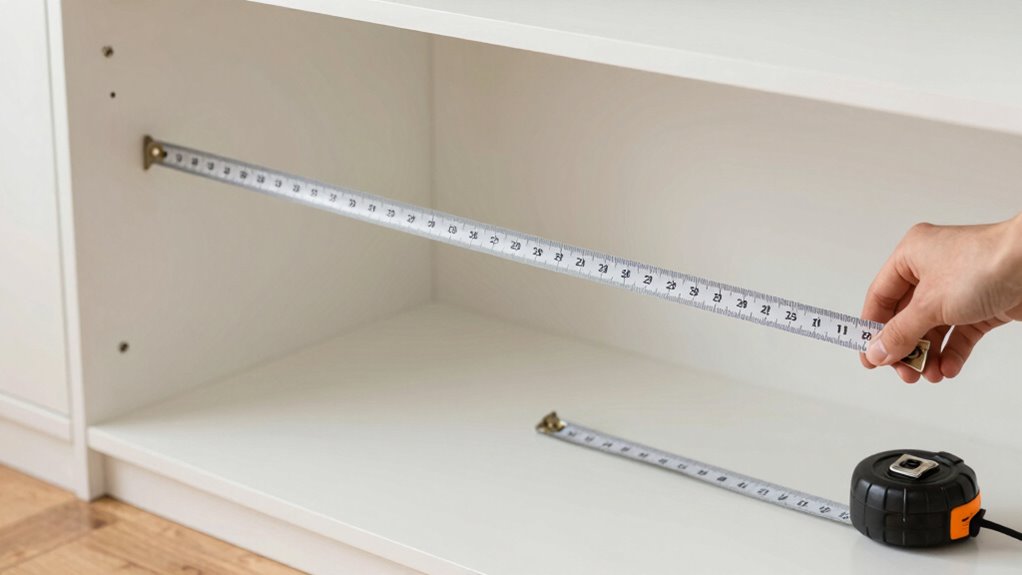

Start by measuring the total width from wall to wall and the height from the floor to the ceiling. Focus on key areas like shelf depth and hanging rod height, and note any irregularities such as sloped ceilings or obstructions like light switches. Consider door clearance and future storage needs to guarantee your organizers fit perfectly. If you want to learn detailed tips for precise measurement and maximizing your space, keep going.
Key Takeaways
- Measure the total width, height, and depth of the closet to determine available space for organizers.
- Record shelf depth and hanging rod height, ensuring enough clearance for your clothing and items.
- Check for irregularities, obstructions, or features like sloped ceilings that may affect organizer placement.
- Measure door clearance and note any obstructions such as outlets or switches.
- Consider future storage needs to select flexible organizers that fit your space and requirements.
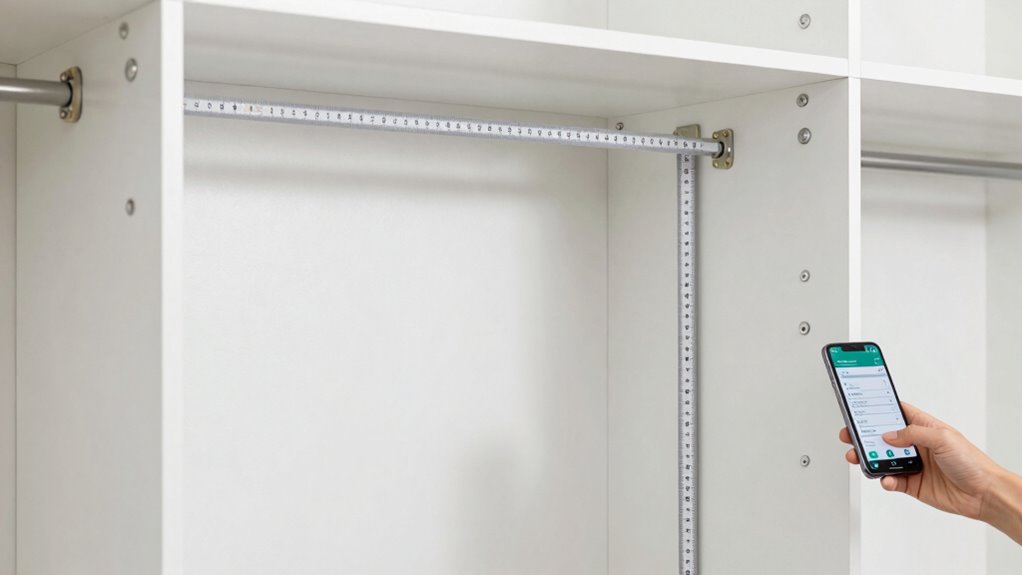
Have you ever struggled to organize your closet because you didn’t know its exact dimensions? If so, you’re not alone. Knowing the precise measurements of your closet is vital before purchasing any organizers or storage solutions. It helps guarantee everything fits perfectly and prevents costly mistakes. The first step is to measure the available space carefully, focusing on key areas like shelf depth and hanging rod height. These measurements will guide you in choosing the right-sized shelves and hanging rods that maximize your storage without overcrowding.
Knowing your closet’s exact size ensures perfect fits and prevents costly mistakes in organizing.
Start by measuring the width and height of your closet. Use a tape measure to determine the total width from wall to wall, and note down the height from the floor to the ceiling. Next, pay close attention to the depth of your shelves. Shelf depth is essential because it determines how much you can store and how accessible your items will be. Measure from the front edge to the back wall, ensuring you leave enough space for easy retrieval. Keep in mind that deeper shelves may hold more, but they can also become cluttered if too deep, making it harder to see or reach items stored at the back.
Another vital measurement is the hanging rod height. Measure from the floor to where you plan to install the rod. Typically, a standard hanging rod height is around 66 to 72 inches from the floor, providing enough space for hanging clothes without dragging on the ground. If you have taller clothing, like dresses or coats, you might want to install a higher rod. Conversely, for shorter items, a lower rod could be more efficient. Remember to measure twice to avoid errors, and consider leaving some extra space above the rod for bulky items or seasonal clothing. Additionally, understanding storage needs can help you decide on the number and placement of shelves and rods for optimal organization. Properly assessing available space ensures that your storage solutions will be both functional and adaptable to your specific requirements.
When measuring for closet organizers, don’t forget to account for door clearance and any obstructions like light switches or outlets. These factors can affect where you place shelves or rods, so taking detailed measurements guarantees everything fits comfortably. Also, note irregularities such as sloped ceilings or uneven walls, which might require custom solutions. Being aware of irregularities in your space can help you plan more effectively and avoid surprises during installation. To ensure the best fit, consider measuring the spacing between fixtures that could impact your storage setup. Additionally, taking into account future storage needs can help you design a flexible organization system that grows with your wardrobe. By accurately measuring these dimensions—especially shelf depth and hanging rod height—you set yourself up for success in creating a functional, organized closet that suits your needs. Taking the time to measure carefully now saves you frustration later and helps you select the perfect storage solutions for your space.

Sakugi Storage Shelves – 5 Tier Shelf Organizer, Heavy Duty Garage Shelving Unit with Leveling Feet, Stable Metal Shelves Organizer for Pantry, Kitchen and Closet, 33.0" W x 12.6" D x 72.0" H, Black
HEAVY-DUTY CONSTRUCTION: The Sakugi wire shelving unit is constructed with high-quality, heavy-duty metal tubes that are 0.9 inches…
As an affiliate, we earn on qualifying purchases.
As an affiliate, we earn on qualifying purchases.
Frequently Asked Questions
What Tools Do I Need to Measure My Closet Accurately?
You need a measuring tape and a laser ruler to measure your closet accurately. The measuring tape is perfect for measuring lengths, widths, and heights, especially around corners or irregular spaces. A laser ruler provides precise measurements quickly, especially for larger or hard-to-reach areas. Use both tools to get detailed measurements of your closet’s dimensions, ensuring your organizers fit perfectly and maximize your space.
How Do I Measure Irregularly Shaped Closets?
Did you know irregularly shaped closets make up about 30% of homes? To measure yours, start by sketching the space’s outline on paper, noting every nook and cranny. Use a flexible tape measure to record each segment’s length and width, especially in corners or odd angles. For custom closet dimensions, consider irregular shape solutions like corner shelves or angled rods to maximize space efficiently.
Should I Measure for Future Organizer Additions?
Yes, you should measure for future expansion when planning your closet organizers. By leaving extra space, you can add new compartments or shelves later without hassle. Consider the potential for additional storage needs and make certain your current measurements account for this growth. Doing so makes it easier to upgrade or modify your closet as your storage requirements change, saving you time and money in the long run.
How Do I Account for Door Swings When Measuring?
When measuring for door swings, you need to account for door clearance and hinge clearance. Open the door fully and measure the space from the door edge to the wall or any obstructions, ensuring there’s enough room for the door to swing freely. Include hinge clearance in your measurements, especially if the hinges extend into the closet space. This way, your organizers won’t block door movement or cause interference.
What’s the Best Way to Record Measurements for Planning?
Imagine your closet bursting at the seams with chaos—now, grab your tape measure and record each dimension precisely. Note the height of shelves for perfect fit, and consider how color coordination can influence your layout. Write down every measurement clearly, including door swings, so you avoid surprises. Use a notebook or digital app to keep everything organized. This way, your closet planning becomes effortless, transforming chaos into a sleek, harmonious space.

Adjustable Hanging Closet Rod, Extender Hanging Rod, Closet Hanging Organizer, Heavy Duty Closet Bar, Hanging Rod (1 Pack, Chrome)
Sturdy and Durable: A durable and sturdy hanger bar made of stainless steel, with a corrosion-resistant and shiny…
As an affiliate, we earn on qualifying purchases.
As an affiliate, we earn on qualifying purchases.
Conclusion
Now that you know how to measure your closet, you’re like a master cartographer mapping out uncharted territory. With these measurements, you’ll build a perfectly tailored oasis, turning chaos into calm. Think of your closet as a canvas—your careful measurements are the brushstrokes that create a masterpiece of organization. When you step back, you’ll see a space transformed, a sanctuary where everything has its place, and clutter becomes a distant memory.
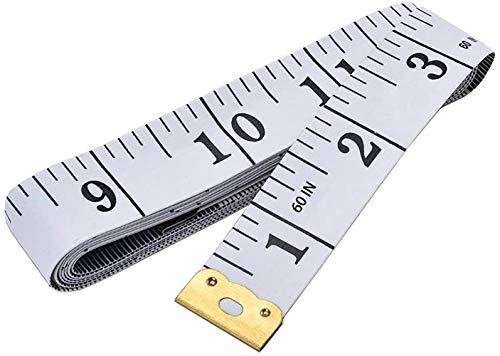
GDMINLO Soft Tape Measure Double Scale Body Sewing Flexible Tailor Craft Vinyl Ruler for Weight Loss Medical Body Measurement, Has Centimetre Scale on Reverse Side 60-inch(White)
Measuring range: 0 to 60 inches and 0 to 150 centimeters. There is a centimeter scale on the…
As an affiliate, we earn on qualifying purchases.
As an affiliate, we earn on qualifying purchases.

Wonderjune 2 Pack Closet Rail Hanging Closet Rod Ceiling Clothes Rack Any Angle Hanging Rail Clothes Rod Wall Mount Sloped Ceiling Closet Solutions for Attic Bedroom Under Stairs Storage (Black)
Wavy Coil Design: an innovative design including 34 wavy coils, this closet rail easily handles at least 34…
As an affiliate, we earn on qualifying purchases.
As an affiliate, we earn on qualifying purchases.