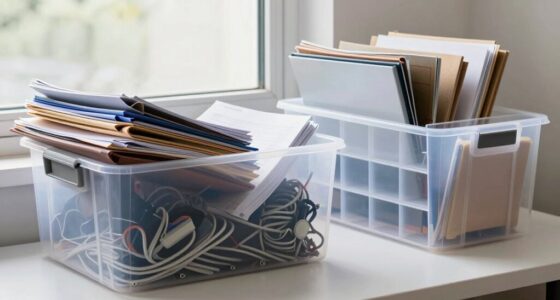

Organizing for retrieval helps you access your items quickly and with less stress, unlike focusing only on looks, which can leave you unprepared in urgent moments. When you use memory cues like labels, color codes, and logical categories, you make it easier to find things fast. This method aligns with how your brain naturally recalls information, saving you time and frustration. If you want to discover effective strategies to improve your organization, keep exploring these helpful tips.
Key Takeaways
- Organizing for retrieval aligns with mental processes, making it easier to find information quickly under pressure.
- Memory cues like labels and color codes enhance recall better than aesthetic arrangements alone.
- Categorization simplifies search and reduces cognitive effort, improving overall efficiency.
- A system focused on mental accessibility saves time and decreases stress during searches.
- Looks-focused organization may be visually appealing but often lacks practical effectiveness for quick access.
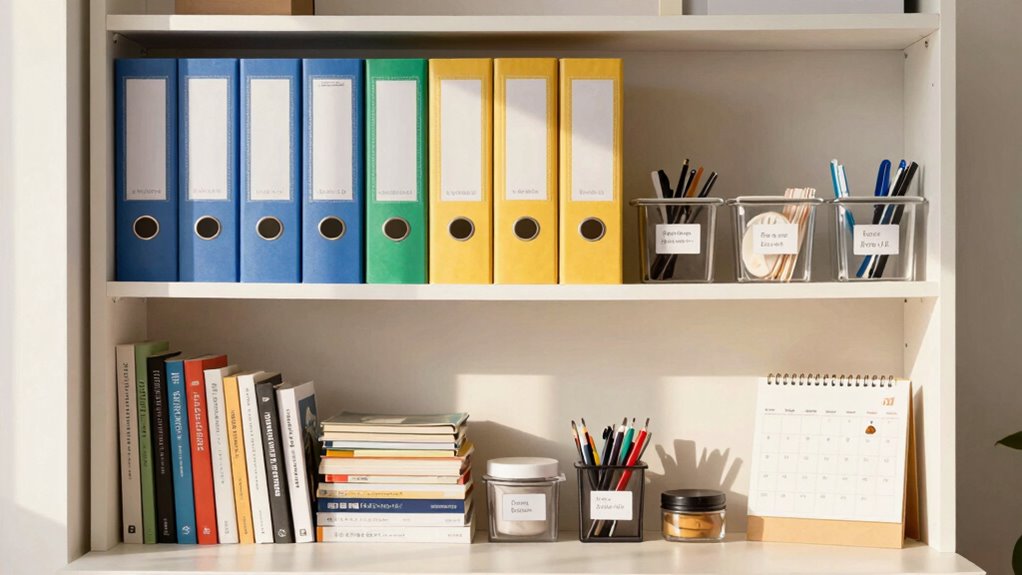
Have you ever struggled to find important information when you needed it most? It’s frustrating when you open a drawer or search through files and come up empty-handed, even though you know the data is somewhere nearby. That’s where organizing for retrieval makes a real difference. Instead of focusing solely on aesthetics or making your space look good, you want to create a system that helps you access what you need quickly and effortlessly. This approach relies on memory cues and categorization strategies that boost your ability to recall information efficiently.
Memory cues are mental signals that trigger your memory, guiding you directly to the information you seek. When your organizational system incorporates clear cues, such as labels, color codes, or distinctive arrangements, you’re more likely to remember where things are. For example, using a specific color for important documents or a dedicated spot for frequently used tools creates visual hints that point you in the right direction. These cues act as mental shortcuts, reducing the cognitive effort needed to locate items. The more intuitive and consistent your cues, the stronger your memory associations become, making retrieval faster and more reliable. Additionally, understanding how memory cues work can help you design more effective storage solutions that align with your natural recall abilities.
Clear labels, color codes, and distinctive arrangements help you find items quickly and reliably.
Categorization strategies complement memory cues by grouping related items together based on shared characteristics. Instead of scattering similar objects or files throughout your space, you assign them to specific categories. This way, when you need something, you can think, “It’s in the finance section,” or “This belongs with other kitchen utensils.” Categorization simplifies your search process because your brain naturally groups related information, allowing you to narrow down your options quickly. When combined with effective memory cues, categorization strategies turn a chaotic mess into a logical, structured system that enhances your ability to retrieve information. Recognizing the importance of mental organization can help you create a more seamless and functional setup that improves efficiency. Furthermore, employing consistent routines can reinforce these efforts by making your system more habitual and easier to maintain over time.
Focusing solely on appearance might make your space look neat, but it doesn’t necessarily help you find what you need when it counts. You might have a beautifully organized cabinet, but if the arrangement isn’t based on how you think or remember, it might still be difficult to locate items under pressure. Organizing for retrieval emphasizes creating a system that aligns with your mental processes, making it easier to recall information through well-placed cues and thoughtful grouping. When your organization is designed with retrieval in mind, you save time, reduce stress, and improve your overall efficiency. This approach ensures the effort you put into organization pays off when you actually need access to your stored information.

Brother P-Touch PT-N10 Personal Handheld Label Maker, Portable and Prints, P-Touch Btag ~½” (12mm) Wide Color Personalized Label Tapes,
- Portable handheld label maker: Ideal for organizing on the go
- Customizable Btag tapes: Use with ½” wide, 13.1’ long tapes
- Colorful tape options: Available in 17 vibrant colors
As an affiliate, we earn on qualifying purchases.
As an affiliate, we earn on qualifying purchases.
Frequently Asked Questions
How Do I Balance Aesthetics With Functionality in Organization?
You balance aesthetics with functionality by prioritizing visual harmony while ensuring easy access. Use attractive storage solutions that also enhance spatial efficiency, like stylish baskets or sleek shelves. Keep frequently used items within reach and neatly organized, so your space looks good and functions smoothly. This approach helps you enjoy a beautiful environment that’s also practical, making everyday tasks easier and more enjoyable.
What Tools Help Improve Retrieval Efficiency?
You can improve retrieval efficiency with tools like clear categorization strategies and effective labeling techniques. For example, in a home office, using color-coded folders for documents and labeled storage bins helps you quickly locate what you need. These tools streamline your organization by making items easily identifiable, reducing search time, and ensuring that both aesthetics and functionality work together seamlessly.
How Often Should I Reorganize for Better Retrieval?
You should reorganize your storage habits at least every few months to maintain ideal retrieval efficiency. Regular updates help you adjust for new items and changing retrieval triggers, ensuring everything stays accessible. If you notice items becoming harder to find or your system feels cluttered, reorganize sooner. Consistent reorganization keeps your setup aligned with your needs, making retrieval quicker and less frustrating over time.
Can Digital Organization Methods Enhance Physical Retrieval?
A place for everything, and everything in its place—that’s your goal. Digital organization methods like digital cataloging and cloud storage can considerably improve your physical retrieval. When you label and categorize files digitally, it’s easier to locate physical items, saving you time and frustration. Digital tools create a system that supports quick access, making the physical world more organized and efficient, just like a well-structured digital archive.
What Are Common Mistakes in Organizing for Retrieval?
You often make the mistake of ignoring visual clutter, which hampers quick retrieval, or inconsistent labels that cause confusion. To improve, keep your space tidy and minimize unnecessary items. Use clear, consistent labels so you can easily identify what you need. Avoid overloading shelves or drawers, and regularly review your organization system. These habits help you find things faster and prevent frustration caused by disorganized spaces.
As an affiliate, we earn on qualifying purchases.
Conclusion
Think of your bookshelf not just as a display case but as a treasure map. When you organize for retrieval, you’re creating pathways to hidden gems, making it easy to find what you seek. Just like a well-marked trail leads adventurers to their destination, your smart organization guides you effortlessly to your next read. So, choose function over form—your future self will thank you for the adventure you’ve prepared.
categorization storage containers
As an affiliate, we earn on qualifying purchases.
As an affiliate, we earn on qualifying purchases.
As an affiliate, we earn on qualifying purchases.