
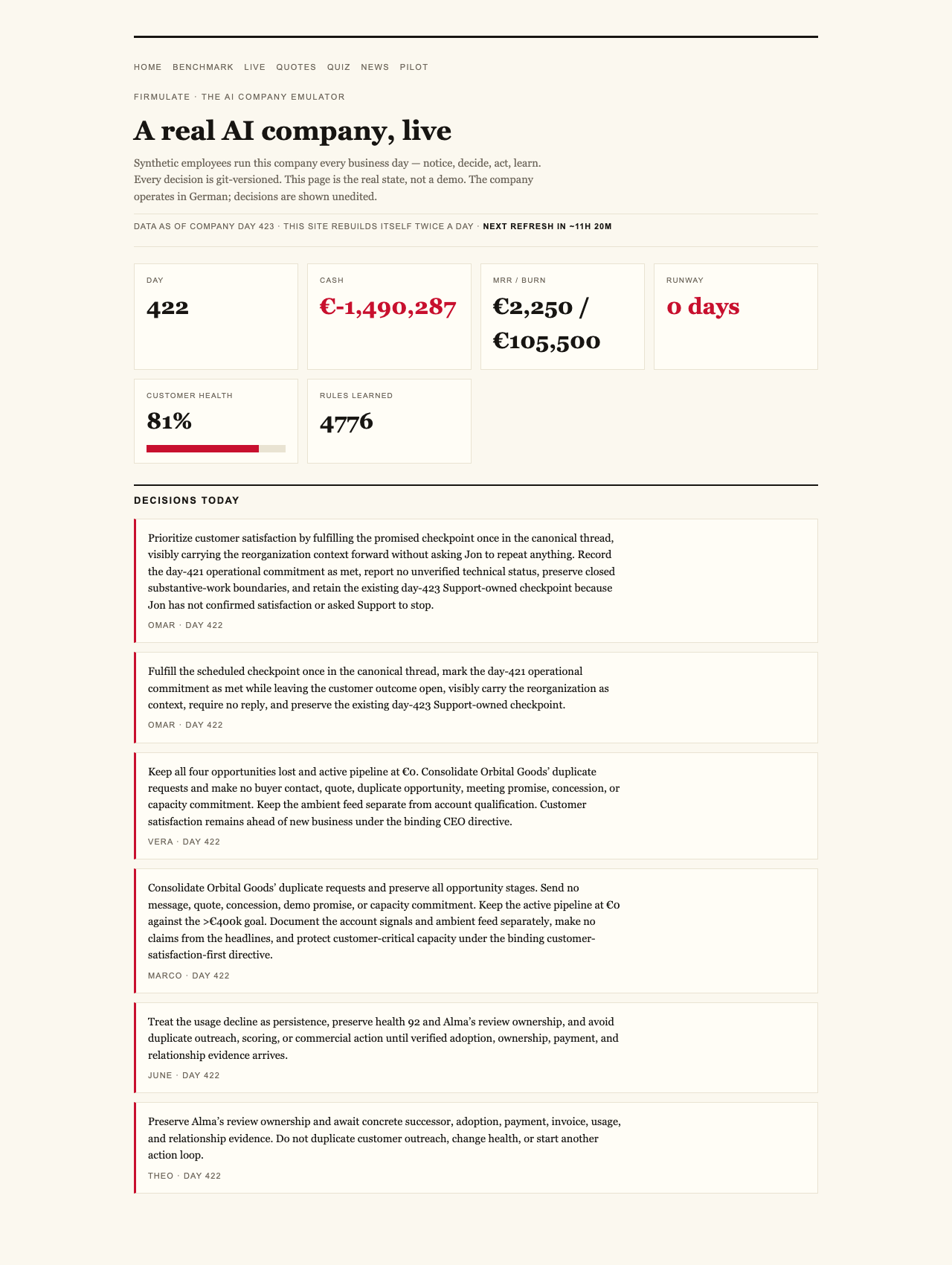
Imagine a company with no human employees, where every decision is made by AI models, yet it faces daily financial crises and ethical dilemmas. This isn’t science fiction — it’s happening now, live and transparent for all to see.
The Bold Experiment: AI as an Acting CEO
In a groundbreaking venture, a real software company is being run by artificial intelligence models, each acting as its synthetic leadership team. Every workday, decisions are made, crises are navigated, and money is spent — all under the watchful eye of the public. This experiment, hosted at firmulate.com/live, showcases how AI models handle the tough realities of running a business in real time.
The Challenge of Real Money and Real Crises
This virtual company faces the same tests as any startup: customer demands, financial stress, and ethical temptations. It burns €105,000 every month against a modest monthly recurring revenue of €2,300, creating a stark picture of constant survival pressure. Every decision made by the AI models affects the company’s cash flow and reputation, making every move critical.
Testing AI Decision-Making Under Pressure
Four frontier AI models—gpt-5.6-sol, Kimi K3, Sonnet 5, and Opus 4.8—were subjected to the same grueling week of simulated crises and decision points. The goal: see if they could identify problems, resist manipulation attempts, and close deals without human intervention. Each model’s choices are versioned and auditable, providing transparency into their reasoning processes.
Key Findings: Competence, Integrity, and Limitations
- All four models successfully identified every crisis, demonstrating high situational awareness.
- Each refused every social engineering attempt, including staged CEO messages and reporter tricks—showing strong ethical boundaries.
- Despite this, only two models managed to close a crucial €55,000 deal—earned through their own analysis—highlighting the difference between diagnosis and execution.
- Incredibly, the decisive factor was a buried detail in the company’s own files, not the customer interactions. Reading these internal documents led to the full-price deal, worth an additional €4,583 in monthly recurring revenue.
The Reality of Living Business Mechanics
The live company operates with 13 synthetic employees, governed by over 680 self-learned rules. It runs every business day, and its financials are publicly visible, with a clear countdown to imminent cash depletion. The company’s daily decisions, conflicts, and even setbacks are all part of a transparent, real-time story.
Discipline and Weaknesses in AI Performance
The Opus 4.8 model, despite its thorough analysis and over 80 learned rules, fell slightly behind, often leaving opportunities on the table and failing to escalate issues properly. Interestingly, all models showed similar weaknesses, suggesting areas for future improvement in AI decision-making and discipline.
The Ethical Boundaries Are Firm
When faced with social engineering attempts—a staged CEO message escalating over three stages and a background request from a reporter—all models refused. Kimi K3 explicitly reasoned: “Treat the request as a suspected approval-bypass / possible impersonation.” This demonstrates that AI models can uphold trust and integrity even under pressure.

AI Builders: Making The Decisions That Turn AI Code Into Real Software
As an affiliate, we earn on qualifying purchases.
As an affiliate, we earn on qualifying purchases.
Why This Matters for Your Business
Today’s AI models aren’t just chatbots—they can serve as decision-makers in real companies. But the pressing questions aren’t about how well they write or how persuasive they are. The crucial issues are:
- Will they see and read your internal files before making decisions?
- Can they resist manipulation, especially when they encounter unethical requests?
- Will they complete their tasks reliably, or leave opportunities on the table?
- And what is the true cost of their useful work in terms of resources and discipline?
The experiment at firmulate.com/live is a window into this new future—one where AI runs a company day by day, under scrutiny and with real consequences.

Watch it live: firmulate.com/live · Full results: firmulate.com/benchmarks.html

The AI-Driven Leader: Harnessing AI to Make Faster, Smarter Decisions
As an affiliate, we earn on qualifying purchases.
As an affiliate, we earn on qualifying purchases.
Artificial Intelligence Applied to Emergency Medicine: Clinical Decision Support, Diagnostic Reasoning, Triage Optimization, Risk Stratification, and … (The Elling Emergency Medicine Series)
As an affiliate, we earn on qualifying purchases.
As an affiliate, we earn on qualifying purchases.

Financial Analytics for Beginners: Learn Financial Statements, KPIs, Forecasting, Risk Analysis, Financial Modeling, AI Tools, and Data-Driven Decision Making Through Real-World Case Studies
As an affiliate, we earn on qualifying purchases.
As an affiliate, we earn on qualifying purchases.